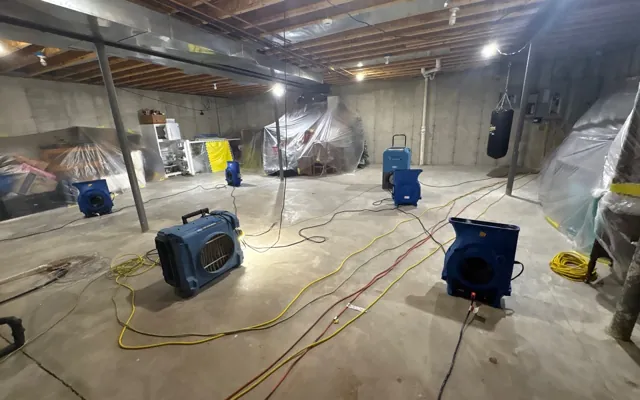
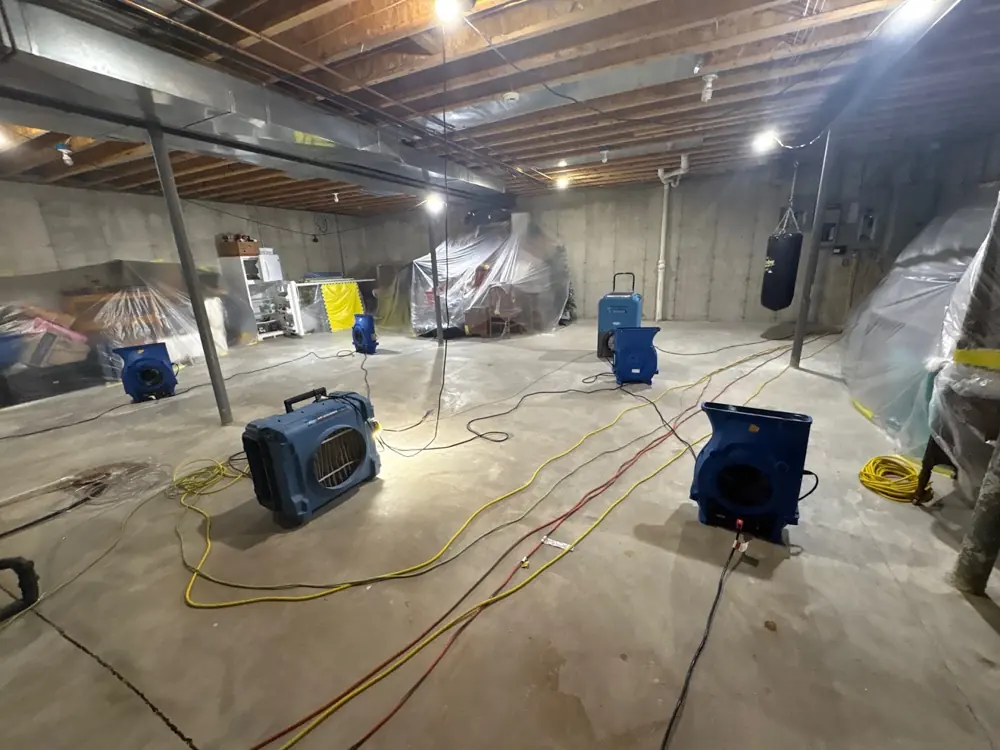
True basements are rare in Dallas. What homeowners here actually face is ground-floor and garage flooding on a slab foundation, and it spreads just as fast and needs the same urgent extraction and moisture-verified drying.

Dispatch runs any hour, and a crew is typically on site in about an hour to shut off standing electrical hazards before anyone enters the flooded rooms.
Submersible pumps and truck-mounted units pull standing water from garages, entries, and living space, clearing the lowest points of the slab first.
Wet baseboard, flooring, and lower drywall are opened or removed where water traveled, since a slab spreads water sideways into walls rather than down.
Air movers and dehumidifiers are set across the affected footprint, and moisture is checked daily until every material reads dry, with readings logged for the claim.

While help is on the way, these first steps, done only where it is safe, limit the damage and protect the insurance claim.
Shut the supply off at the source, or close the home's main valve if the source is not obvious. Stopping the flow limits the damage more than anything else.
Switch off electricity to the affected area, but only if the breaker can be reached without standing in or touching the water.
Get a crew dispatched right away. The sooner extraction and drying begin, the more flooring, drywall, and belongings can be saved.
Take photos and a short video of the water and the affected rooms before anything is moved, so the insurance claim starts strong.
Ground-floor flood cleanup in Dallas typically runs from about $1,500 to $6,500, depending on how many rooms flooded and how far water pushed into walls and cabinetry. A whole-home event from a burst line or storm intrusion lands at the higher end, while garage-only flooding is usually less since garages rarely have carpet or finished drywall low on the wall. Most sudden, accidental flood losses are covered by homeowners insurance, and the crew documents moisture readings and photos for the carrier.
Crews reach Dallas, Dallas County, and the surrounding North Texas communities fast, from Oak Cliff, the Bishop Arts District, and Lakewood to Highland Park, University Park, Irving, Richardson, and Garland. See the full list on the areas served across Dallas page.
See all areas servedEvery loss is photographed, measured, and logged from the first visit, so the paperwork holds up with the insurance carrier.
Technicians follow recognized IICRC drying standards and prove it with daily moisture readings on Dallas homes, not guesswork.
Emergency dispatch any hour of the day or night, with a real crew on the way across North Texas, not a callback in the morning.
A real crew dispatched any hour, not a callback in the morning.
Trained technicians following recognized IICRC drying standards.
Truck-mounted, portable, and submersible for any size loss.
The loss is documented and billed to the carrier directly.
Almost none. Dallas sits on expansive clay soil, so homes are built slab-on-grade. A few older or custom properties have small cellars, but a true finished basement is rare across North Texas.
It spreads sideways across ground-floor rooms, garages, and entries rather than pooling below grade, and it wicks up into baseboards, cabinets, and drywall just as a basement flood would.
Dispatch runs 24/7 with typical arrival in about an hour anywhere in Dallas or Dallas County, because floodwater on a slab moves quickly into adjoining rooms.
Sometimes. Clean water on hard flooring can often be extracted and dried in place, but carpet pad, wet drywall near the floor line, and swollen baseboard usually have to come out so hidden moisture is not sealed in.
Sudden, accidental flooding from a storm, pipe failure, or slab crack is commonly covered under homeowners policies. Moisture readings and photos are documented for direct submission to the carrier.
Dallas crews are on call 24 hours a day, local and fast, and can be on the way within the hour.
Call (945) 307-0757