True ice dams are rare on Dallas roofs, but a prolonged hard freeze can leave ice and refrozen melt that forces water under shingles. Local crews respond to dry the ceilings and walls that result.

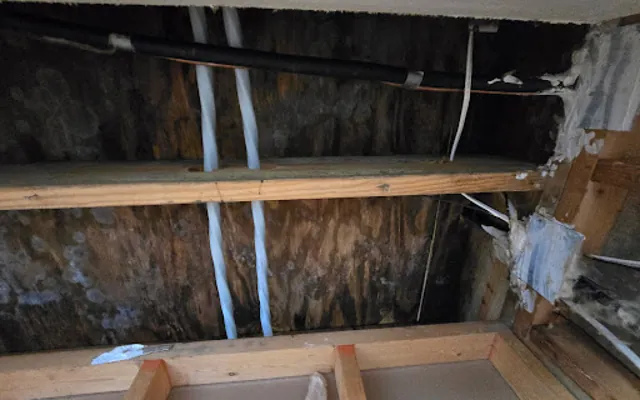
A crew inspects the ceilings, attic, and exterior walls once the ice melts, tracing where meltwater backed up under the roofing and entered the home.
Trapped water behind bulging ceilings is relieved in a controlled way, and saturated insulation and drywall around the intrusion are removed.
Air movers and dehumidifiers dry the attic framing, ceiling assembly, and any wet wall cavities, with moisture checked daily until every material reads dry.
The affected areas are left ready for a qualified roofing contractor, and readings and photos are documented for the homeowner's insurance carrier.

While help is on the way, these first steps, done only where it is safe, limit the damage and protect the insurance claim.
Shut the supply off at the source, or close the home's main valve if the source is not obvious. Stopping the flow limits the damage more than anything else.
Switch off electricity to the affected area, but only if the breaker can be reached without standing in or touching the water.
Get a crew dispatched right away. The sooner extraction and drying begin, the more flooring, drywall, and belongings can be saved.
Take photos and a short video of the water and the affected rooms before anything is moved, so the insurance claim starts strong.
Because these events are uncommon in Dallas, cleanup varies, commonly from about $1,200 to $5,500 when a hard freeze does force meltwater into a home. Cost depends on how much insulation and ceiling drywall are soaked and how far water traveled along the roof line and walls. The crew documents moisture readings and photos so any covered portion can be submitted to the insurance carrier for review.
Crews reach Dallas, Dallas County, and the surrounding North Texas communities fast, from Oak Cliff, the Bishop Arts District, and Lakewood to Highland Park, University Park, Irving, Richardson, and Garland. See the full list on the areas served across Dallas page.
See all areas servedEvery loss is photographed, measured, and logged from the first visit, so the paperwork holds up with the insurance carrier.
Technicians follow recognized IICRC drying standards and prove it with daily moisture readings on Dallas homes, not guesswork.
Emergency dispatch any hour of the day or night, with a real crew on the way across North Texas, not a callback in the morning.
A real crew dispatched any hour, not a callback in the morning.
Trained technicians following recognized IICRC drying standards.
Truck-mounted, portable, and submersible for any size loss.
The loss is documented and billed to the carrier directly.
Very rarely. The mild winters here, with little lasting snow, mean most roofs never form one. They become a risk only during severe, prolonged freezes like February 2021, when ice and refrozen sleet linger on roofs for days.
The entry point differs but the interior damage is similar. Meltwater backs up under shingles rather than through a wind-torn area, then shows up as the same stained ceilings, wet insulation, and damp walls that any roof leak causes.
It is safer not to. Climbing an icy roof is dangerous, and chipping at ice can damage shingles. The priority is drying the interior water damage and having a qualified roofing contractor address the roof once it is safe.
Sudden water intrusion from a freeze event is commonly covered under homeowners policies. The crew documents the cause, moisture readings, and photos so the homeowner can submit a clear claim to the carrier.
Dallas crews are on call 24 hours a day, local and fast, and can be on the way within the hour.
Call (945) 307-0757